
HOME
 To the ENGLISH website
 Naar NEDERLANDSE website
 Contact me
Disclaimer
YOUR HISTIO STORY
I am looking for similarities
in all individual cases of
Histiocytic diseases.
I wonder if we all tell our
stories we might come up
with some commonality
between the specific
situations in which all of
our pets got this disease.
So please email me the
details and I'll put your
pets story on Shelley's
Histio Website
UW HISTIO VERHAAL
Ik ben op zoek naar
overeenkomsten in alle
individuele gevallen van
Histiocytose.
Ik hoop dat wanneer wij
onze Histio verhalen
vertellen, wij overeen-
komsten ontdekken over
de manier waarop onze
huisdieren deze ziekte
hebben opgelopen.
Stuur mij de details en
ik zal het verhaal van uw
huisdier op de Histio
website van Shelley zetten.
WARNING !
These stories are all
different. Individual
symptoms, situations
and circumstances
may vary and response to
therapy is not always the
same.
- Disclaimer -
WAARSCHUWING !
Deze verhalen zijn allemaal
verschillend. Individuele
symptomen, situaties en
omstandigheden kunnen
verschillen en de reactie
op therapie is niet altijd
hetzelfde.
- Disclaimer -

HISTIOCYTOSIS IN
OTHER LANGUAGES
German - Hund
Maligner Histiozytose
French - Chien
l'Histiocytose Maligne
Italian - Canis
Maligni Histiocytosis
Spanish - Perros
Histiocitosis Maligna
Dutch - Hond
Maligne Histiocytose
Survey report for histiocytic diseases in dogs !
Data collected by Mo van den Tillaart
In loving memory of my Sheltie Shelley who died of Malignant Histiocytosis in 2001,
and all other pets who fell victim to this dreadful disease.

This histio survey report is to determine the frequency and/or possible causes of histiocytic diseases in all dog breeds. It is an ongoing research, so if you have/had an histio stricken dog, please complete the questionnaire and send it to me.
(Please note that I will update the report with newly available data on a regular basis)
Warning: This report consists entirely of information provided by third parties and most respondents have not answered every question, which resulted in a lower sample size for some questions. Also this is my own interpretation of the data received. Therefore I hereby disclaim any liability for the accuracy or meaning of any such information provided in this survey report. The results of this survey should be interpreted with caution. Users hereby agree to use or rely on this information solely at their own risk.

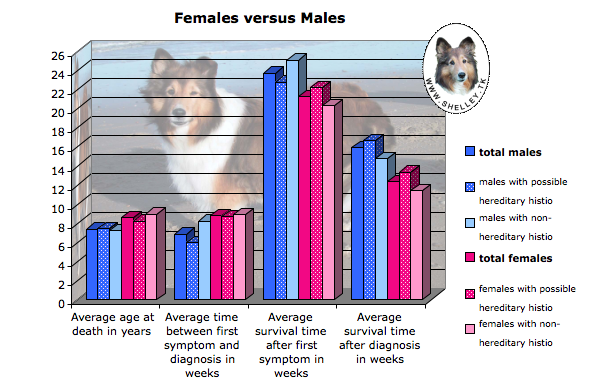
So far:
87 questionnaires were filled out.
40 were males and
47 females.
73 dogs were neutered or spayed and
12 were intact.
(two owners did not answer the neutered/spayed question.)
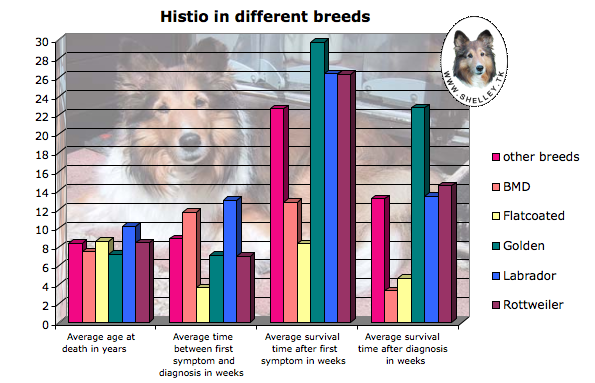
1 Australian Blue Cattle Dog
2 Australian Shepherds
3 Beagles
11 Bernese Mountain Dogs
1 Bichon
2 Border Collies
1 Corgi (pembroke welsh)
2 Dobermanns
3 Flatcoated Retrievers
19 Golden Retrievers
1 Greater Swiss Mountain Dog
1 Greyhound (Italian)
1 Irish Setter
1 Jack Russel
2 Labrador Retrievers
1 Maltese Terrier
4 Mastiffs
1 Mini Pinscher
8 mixed breeds
1 Pekingese
1 Rhodesian Ridgeback
8 Rottweilers
4 Scottisch Terriers
7 Shelties
1 Siberian Husky
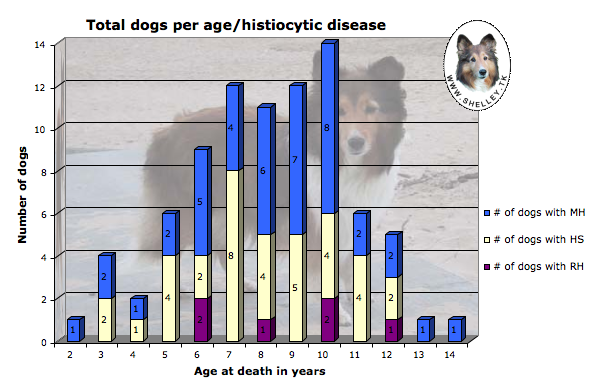
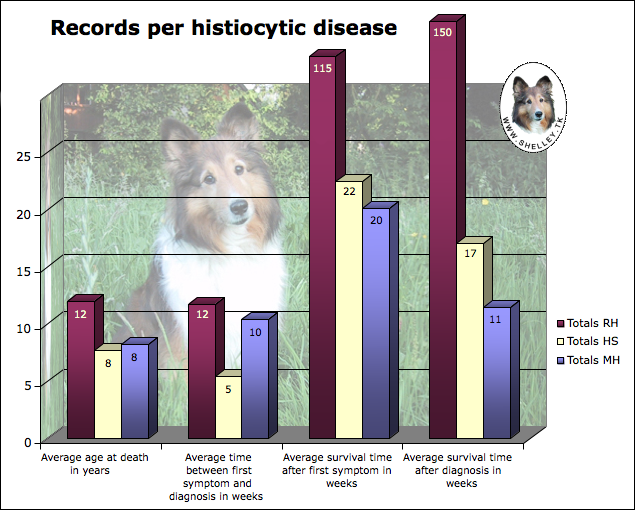
44 dogs were diagnosed with Malignant Histiocytosis (MH), 20 males and 24 females.
 Oldest dog in this survey who died of MH was an almost 14 year old spayed female Terrier mix.
The youngest dog was an only 1 year and 7 months young spayed female Labrador/Akita mix.
Average survival time after diagnosis is 11 weeks.
Longest survival time after diagnosis was 97 weeks for Buddy, a 9 year old neutered male Golden Retriever.
He had a splenectomy and did not get any medicines because of his sensitive stomach.
Click here to read Buddy's story.
Oldest dog in this survey who died of MH was an almost 14 year old spayed female Terrier mix.
The youngest dog was an only 1 year and 7 months young spayed female Labrador/Akita mix.
Average survival time after diagnosis is 11 weeks.
Longest survival time after diagnosis was 97 weeks for Buddy, a 9 year old neutered male Golden Retriever.
He had a splenectomy and did not get any medicines because of his sensitive stomach.
Click here to read Buddy's story.37 dogs were diagnosed with Histiocytic Sarcoma (HS), 16 males and 21 females.
Oldest dog in this survey who died of HS was an almost 12 year old spayed female Labrador Retriever.
The youngest dog was an almost 3 year young male Golden Retriever.
Average survival time after diagnosis is 17 weeks.
Longest survival time after diagnosis was 127 weeks for Rosie, a 6 year old spayed female Golden Retriever
She was treated with surgery for better margins after initial surgery and was given chemo therapy:
CCNU (lomustine), cyclophosphamide and Doxorubicin.
Click here to read Rosie's story.6 dogs were diagnosed with Reactive Histiocytosis (RH), 4 males and 2 females.
Oldest dog in this group who died was a 10 year old spayed female Beagle, diagnosed with systemic histiocytosis (SH).
The youngest dog was an 8,5 year old intact male BMD, also diagnosed with SH.
Residence
Of all 87 Histio cases,
66 dogs lived in the United States of America:
1 in Arizona,
9 in California,
3 in Colorado,
3 in Florida,
2 in Georgia,
5 in Illinois,
1 in Indiana,
1 in Maine,
1 in Maryland,
2 in Massachesetts,
1 in Michigan,
1 in Minnesota,
1 in Missouri,
2 in Nevada,
2 in New Hampshire,
2 in New Jersey,
4 in New York,
3 in North Carolina,
4 in Ohio,
2 in Oregon,
1 in Pennsylvania,
2 in South Carolina,
1 in Tennessee,
2 in Texas,
3 in Washington,
1 in Wisconsin and
3 in Wyoming.
3 dogs lived in Canada,
2 dogs lived in Australia:
1 in ACT and
1 in Queensland.
15 lived in Europe:
1 in Italy,
8 in the Netherlands,
1 in Scotland and
5 in the UK.
1 lived in South Africa.
Source
Most dogs (
39 ) came from an established breeder,
8 from a casual breeder,
9 from a backyard breeder and
12 dogs came from a shelter or rescue organization.
7 from a private party, like a friend or neighbor.
7 were from a petstore,
1 from a newspaper add,
2 were stray dogs and
2 owners did not answer this question.
Some dogs diagnosed with HS had multiple tumors in different parts of their bodies.
Therefore I doubt whether their actual diagnosis is correct.
Health issues prior to histiocytic disease
As for health issues in life before the onset of an histiocytic
disease, multiple answers were possible. From a total of
87 dogs in this survey,
33 had no prior health issues and only
2 owners did not fill out this question. This leaves
52 dogs with one or more health issues prior to the onset of their histiocytic disease.
The breakdown for reported health issues is:
35 dogs had fatty tumors,
11 had orthopedic disorders,
7 digestive disorders and
9 torn ligaments/tendons.
10 dogs had reactions to drugs,
7 had allergies,
6 chronic infections,
6 parasitic diseases,
6 other tumors,
3 urinary problems,
6 reactions to vaccinations,
2 dental problems,
2 eye problems,
2 respiratory disorders,
2 seizures and
4 skin disorders.
All other health issues in these dogs were reported only once:
like:
autoimmune disease,
enlarged prostate,
kidney disease,
poisoned,
thyroid disease,
tonsilectomy,
viral diseases,
weight problems and
wounds/cuts.
Treatment for health issues within 6 months prior to histiocytic disease
From a total of
87 dogs,
44 needed no treatment prior to the onset of their histiocytic disease.
1 owner did not remember any health issues and
14 owners did not fill out this question. This leaves
28 dogs who received some form of treatment in the 6 months prior to the onset of
their histiocytic disease.
2 dogs were given anesthesia and
3 steroids (Prednison).
1 dog was given 15 different meds in an attempt to control her neosporosis.
Medicines used are:
Antibiotics:
3 x Baytril
3 x Doxicyclene
2 x Amoxicillin
2 x Cephalexin
2 x Clindamicin
4 people didn't remember the name of the antibiotics. Other antibiotics reported only
once are: ampicillin, ceferal, clavamox, flagyl, gentamicin,
metrodinazole, penicillin and sulfamethazole.
Narcotics:
All these drugs were reported only once:
buprenorphine, fentanyl patch, gabopentin, percocet, procaine and tramadol.
Non Steroid Anti inflammatory meds:
3 people didn't remember the name of the medicine they gave their dog
5 x Metacam
5 x Rimadyl
2 x Deramaxx
1 x Carthrophen
1 x Previcox
Gastroprokinetic agent
1 x Centrine
1 x Metaclopramide
1 x Omeprazole
1 x Sucralfate
Other medicines:
3 x Benadryl (allergy)
1 x Atarax (allergy)
1 x Denosyl (Anti Oxidant)
1 x Phenobarbital (Anti Seizure)
1 x Protexin (Probiotics)
1 x Enalapril and
1 x Benazepril (Angiotensin)
1 x Soloxine (Thyroid)
1 x Pyridostigmine (anticholinesterase)
Misdiagnosis
40 dogs were NOT misdiagnosed and
1 owner did not fill out this question, but the remaining
46 dogs were diagnosed with another disease while in fact
suffering from a histiocytic disease.
1 owner said his dog was misdiagnosed, but didn't remember the name of the illness.
2 owners were told their dog had no cancer and one was told her dog was a hypocondriac.
5 dogs were diagnosed to have fatty tumors instead of histio
4 with lymphoma
3 dogs were thought to have a tick borne disease
2 AIHA/IMHA
2 an auto immune disease
2 with bloat
2 gastroenteritis
2 hemangiosarcoma
2 just' a histiocytoma
2 osteosarcoma
2 posioning by parasite/spider
2 thyroid disease and
2 were thought to have pneumonia
Other diseases (only reported once) were:
arthritis, brain tumor, broken bone, burrs in throat,
cervical disc/neurological, clotting disorder, cutaneus histiocytosis, flu,
heart disease, hernia, infection, kidney disease, liver cancer, muscle strain,
pancreatitis, tonsilitis, tooth abcess, unknown cough, uveitus and a weight problem.
Symptoms
Multiple answers were possible.
2 dogs presented no obvious symptoms.
All other
85 dogs had one or multiple obvious symptoms.
The breakdown for the most common symptoms is:
44 x Less/no appetite,
39 x Lethargic/weak,
23 x lesions or lumps,
15 x Limp,
13 x Cough,
12 x Weight loss,
10 x Panting or labored breathing,
10 x Anemic,
9 x Vomitting,
6 x Depression or behavior change,
4 x Seizures,
4 x Diarrhea,
4 x Drinking more,
3 x Fever,
3 x Obvious pain,
2 x Hairloss,
2 x Refusing or difficulty walking,
2 x Restless and
2 x Hypoglemic.
Al remaining symptoms were reported only once:
Constipation, difficulty swallowing, Enlarged heart, Enlarged Spleen, Isolation,
Nasal bleeding, None responsive, Orange Urine,
Reverse Sneezing, Snoring, Squinting Eye, Swollen Stomach, TIA.
Diagnostic methods
1 owner did not fill out this question. In all other
86 cases, several diagnostic methods were used to get a definite diagnosis.
The breakdown for the most common methods is:
59 x biopsy/FNA,
39 x X-ray or scan,
38 x bloodwork,
28 x ultrasound,
11 x surgical removal of tumor and biopsy,
5 x autopsy (necropsy),
2 x histio stain.
Other methods used only once are:
HIG test, opthalmascope, urine analysis, neurological test and the marker test.
Tumor sites
Abnormalities were found in:
38 x Spleen,
25 x Liver,
24 x Lungs,
19 x Lymph nodes,
14 x on the skin,
11 x in the abdomen/intestines,
8 x in the bone,
3 x in the chest,
3 x in a joint,
3 x in the kidneys,
3 x in the neck,
2 x in the esophagus
2 x in the heart and
1x in the brain, eyes, nose and bone marrow
Treatment after diagnosis
9 dogs received no treatment at all after being diagnosed with one of the histiocytic
diseases.
7 dogs were euthanized or died within a week after diagnosis,
5 dogs died before diagnosis, and
1 owner said the dog did get some form of treatment, but did not recall which kind.
24 dogs were given no other treatment than medicines.
7 dogs had cancer surgery to remove the tumor but no other treatment,
10 dogs had cancer surgery and received drug treatment after surgery,
7 dogs had cancer surgery and received chemotherapy treatment plus medication,
4 dogs had cancer surgery and chemotherapy without medication,
2 dogs received chemotherapy without any other treatment,
2 dogs received chemotherapy but the owner does not remember the exact protocol,
7 dogs received chemotherapy and medication ,
1 dog got chemotherapy and radiation. And
1 dog received chemotherapy but it was discontinued after one round.
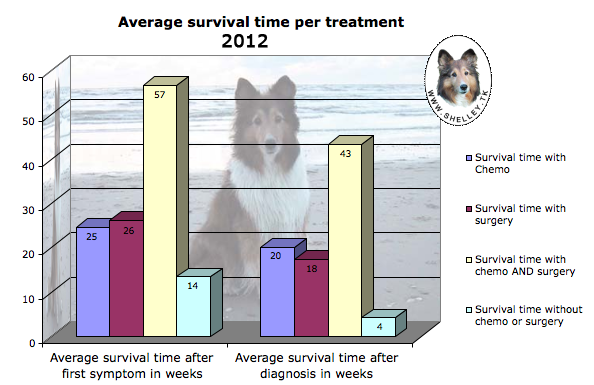
23 dogs were given chemotherapy. In some cases their vets used more than one
chemo protocol. The most used chemotherapy treatment CCNU (Lomustine), was used
20 times. Other chemo protocols used are
3 x Doxorubicin (Adriamycin),
2 x Cyclophosphamide (Cytoxan),
1 x Asparaginase,
1 x Carboplatin and
1 x Vincristine.
Corticosteroids and/or Immunosuppressants were used
33 times. The most prescribed was Prednisone, which was used
32 times.
1 dog was given Ciclosporin.
13 dogs were given painkillers.
3 owners did not recall the name of the medicine. The painkillers used were
3 x Rimadyl,
3 x Tramadol,
2 x Deramaxx,
1 x Cortaphen Forte and
1 x Metacam.
3 Dogs were given Narcotics:
2 x Morphine,
1 x Fentanyl Patch.
Antibiotics were used
11 times and anti nausea medication
7 times.
1 dog was treated with Diazepam (Pamlin)
15 owners tried supplements like antioxidants, CAS option, Chinese herbs, herbal tea,
Omega's 3+6, or vitamins. And
4 owners gave accupuncture a try.
VACCINATIONS
The response to my questions about vaccinations was disappointing. Respondents did either not
remember anything about the vaccinations or did not fill out these questions (completely or partially).
Also many people did not remember exact dates, making this part of the survey practically useless at this moment.
But for the sake of numbers, here are the results so far:

70 people did not split vaccinations for their dog and 17 respondents did not fill out this question.
Combo/Cocktail Vaccination
6 puppies received the combo/cocktail vaccination before they were 6 weeks old,
24 puppies were 6 to 8 weeks old at the time of their first shot,
5 puppies less than 3 months old and
4 puppies were between 3/6 months old.
48 forms had no information about the first ever combo/cocktail vaccination for the puppy.
36 dogs have received an annual booster after their first combo/cocktail vaccination,
3 dogs received a bi-annual booster,
10 dogs received that every 3 years,
3 dogs received boosters depending on titers and
5 dogs were titered and never needed a booster. Leaving
30 dogs, whose owners did not fill out this question.
In
3 dogs the first symptom of histio showed less than one month after they received the last combo/cocktail vaccination, for
3 dogs it was between 1 and 2 months, for
1 dog it was between 2 and 3 months. For
2 other dogs it was between 3 and 6 months and in
43 dogs it was more than 6 months.
5 dogs were vaccinated AFTER the onset of histio and
30 people did not fill out this question.
Rabies Vaccination
3 dogs were never vaccinated against Rabies.
3 dogs received the rabies vaccination before they were 3 months old,
11 dogs were less than half a year old at the time of vaccination,
6 dogs less than 1 year old and
5 dogs were more than a year old.
59 forms had no information about the first rabies vaccination for the dog.
3 dogs were never re-vaccinated against rabies after their first shot.
1 dog received his booster shot only two months after the first shot and then again a year later.
1 dog was only vaccinated against rabies once or twice in its life.
8 dogs received an annual booster,
4 dogs every 2 years,
24 dogs every 3 years, leaving
46 dogs, whose owners did not fill out this question.
In
3 dogs the first symptom of histio showed within less than a month after they received the last rabies vaccination, in
3 other dogs it was between 1 and 2 months, for
1 dog it was between 2 and 3 months, for
1 dog it was between 3 and 6 months and in
21 dogs it was more than 6 months.
3 dogs were vaccinated after the onset of histio and
52 people did not fill out this question.
Kennel Cough Vaccination
11 dogs were never vaccinated against kennel cough.
2 dogs received the kennel cough vaccination when they were less than 3 months old,
2 dogs when they were less than 6 months old,
3 dogs when they were less than 1 year old and
6 dogs were more than a year old.
63 forms had no information about the first kennel cough vaccination for the dog.
1 dog got a booster every 6 months,
4 dogs were vaccinated annually and
2 dogs every 3 years
5 dogs were only vaccinated against kennel cough once or twice in their lives.
2 dogs received a sporadic booster, leaving
62 dogs, whose owners did not fill out this question.
In
2 dogs the first symptom of histio showed within less than a month after it received the last kennel cough vaccination, for
4 other dogs it was between 1 and 2 months and for
11 dogs it was more than 6 months.
59 people did not fill out this question.
Lyme Vaccination
12 dogs were never vaccinated against Lyme.
1 dog received the lyme vaccination when it was less than 3 months old,
2 dogs received the lyme vaccination before they were 1 year old and
4 dogs were more than a year old.
68 forms had no information about the first lyme vaccination for the dog.
8 dogs received an annual booster,
1 dog only once,
12 never and
66 people did not fill out this question.
In
1 dog the first symptom of histio showed within less than a month after it received the last vaccination. For
1 dog it was between 3 and 6 months. And for
5 dogs it was more than 6 months.
1 dog was vaccinated after the onset of histio, and
67 people did not fill out this question.

Flea Preventative
25 Dogs received a monthly flea preventative and
11 only during the summer months.
11 owners gave their dog a flea preventative, but don't remember the protocol.
23 dogs didn't receive any flea treatment at all.
12 only sporadic,
1 only once and
4 owners did not fill out this question.
The brands used were:
4 x Advantage,
4 x Advantix,
2 x Biospot,
2 x Bob Martin,
1 x Capstar,
1 x Comfortis,
40 x Frontline,
2 x Hartz,
1 x Prevention,
1 x Promeris,
1 x Revolution and
1 x Sentinel.
Tick Preventative
21 Dogs received a monthly tick preventative and
11 only during the summer months.
9 owners gave their dog a tick preventative, but don't remember the protocol.
25 dogs didn't receive any tick treatment at all.
12 only sporadic.
8 owners did not fill out this question. And only
1 dog was treated with an annual Lyme vaccination.
The brands used were:
1 x Advantage,
4 x Advantix,
3 x Biospot,
1 x Bob Martin,
1 x Comfortis,
36 x Frontline,
1 x Hartz,
1 x Preventic,
1 x Orevention,
1 x Promeris,
3 x Revolution,
1 x Scalibor and
1 x Sentinel.
Heartworm Preventative
22 dogs received some form of heartworm preventative but the owners don't remember the protocol.
21 dogs didn't receive any heartworm treatment at all.
26 dogs monthly all year long, and
7 only during summer months.
1 dog twice a year and
3 sporadic.
6 owners did not fill out this question. And
1 owner reported that his dog was vaccinated against heartworm with Guardian.
The brands used were:
1 x Advantix,
1 x Bob Martin,
1 x Hartz,
31 x Heartguard,
15 x Interceptor,
3 x Iverheart,
2 x Ivermectin,
1 x Proheart injection,
2 x Revolution and
1 x Scalibor.
Worming Prevention
A majority of respondents (
61 ) reported not to deworm their dogs. In general these are dogs that already received
heartworm treatment, so no regular deworming was necessary.
2 dogs received a quarterly worming prevention,
6 every half year,
4 annual and
2 sporadic.
2 owners did not remember the protocol and
10 people did not fill out this question.
The brands used were:
1 x dog + cat,
1 x Bob Martin,
6 x Drontal,
1 x Excil and
2 x Milbemax.
Lice
One owner reported having his dog treated against lice (Advocate) more
than a year before the onset of her dogs histiocytic sarcoma.
Diet:
The vast majority (
50 ) of respondents fed their dogs commerical food.
2 prepared homemade meals for their dog and
8 people combined homemade meals with commerical food.
16 others fed their dogs a combination of trable scraps with commercial food.
1 person fed her dog RAW only and
5 dogs got RAW combined with commerical food.
5 people did not fill out this question.
The break down by most used brands is as follows:
10 x IAMS
9 x Purina Beneful
8 x Eukanuba
6 x Innova
6 x Proplan
5 x Nutro natural choice
5 x Pedigree
4 x Canidea
4 x Hill's
5 x Wellness
3 x California Natural
2 x Ceasar
2 x Dog Chow
2 x Evo
2 x Merrick's
2 x Natural Balance
The remaining foods are all reported only once:
Bakers,
Blue Buffalo,
Bonzo,
Bravo,
Butchers,
Carnibest,
Chickensoup for the doglovers soul,
Costco,
Diamond,
Eagle Pack,
Flint River Ranch,
Friskies,
Kirkland,
Lucky Dog,
Mark's + Spencers,
Member's Mark,
Nature's Domain,
Nature's Gift,
Nature's Recipe,
Nature's variety,
Pittah,
Repnor Gold,
Royal Canine,
Scoots,
Sensible Choice,
Solid Gold,
Summit,
Taste of the Wild,
Tesco,
and Various.
Most respondents (
55 ) indicated no supplements.
The most used supplements are:
16 x Glucosamine,
7 x Fish oil,
4 x Omega 3-6-9,
4 x Vitamines,
3 x Veggies and/or fruit,
2 x Flaxseed,
2 x Maitake,
2 x Missing Link.

Change in Diet
68 owners said they had not changed their dogs diet. And 3 owners did not remember, or did not fill out this question. For 2 dogs the onset of histiocytic disease was at less than 1 month after the change of diet. For 1 dog it was between 1 and 2 months, for 2 dogs it was between 2 and 3 months, for 3 dogs it was between 3 and 6 months and for 6 dogs it was after more than 6 months. 2 owners changed the diet of their dog, but did not remember the time between the diet change and the onset of the histiocytic disease.
Lawn/mosquito/ant treatment by government or private party
48 owners said no treatment was used and 11 did not fill out this question or did not remember. For 3 dogs the onset of histiocytic disease was within less than a month after being exposed to such a treatment. For 2 dog it was between 1 and 2 months, for 1 dog it was between 2 and 3 months, for 1 dog it was between 3 and 6 months and for 5 dogs it was after more than 6 months. 16 owners did recall the use of a treatment but did not remember the time between the use of the treatment and the onset of the histiocytic disease.
Remodel home or move
60 owners said they did not move or remodel their home and 6 did not fill out this question or did not remember. For 3 dogs the onset of histiocytic disease was within less than a month after the remodel or move. For 0 dogs it was between 1 and 2 months, for 4 dogs it was between 2 and 3 months, for 0 dogs it was between 3 and 6 months and for 12 dogs it was after more than 6 months. 2 owners did recall the remodel/move but did not remember the time between the occasion and the onset of the histiocytic disease.
Introduction of another pet
67 owners said they had not introduced another pet into the household and 3 did not fill out this question or did not remember. For 1 dog the onset of histiocytic disease was within less than a month after the introduction of the new pet; for 4 dogs it was between 1 and 2 months, for 1 dog it was between 2 and 3 months, for 1 dog it was between 3 and 6 months and for 10 dogs it was after more than 6 months. 0 owner did recall having a new pet but did not remember the time between the introduction and the onset of the histiocytic disease.
Kennel
73 owners said their dog had never been in a kennel and 2 did not fill out this question or did not remember. For 5 dogs the onset of histiocytic disease was less than a month and for 1 dog it was between 1 and 2 months, for 2 dogs it was between 2 and 3 months, for 1 dog it was between 3 and 6 months and for 3 dogs it was after more than 6 months. 0 owner did recall having a new pet but did not remember the time between the introduction and the onset of the histiocytic disease.
Detergent
One owner told me her dog always had a toy in its mouth. The toy was washed regularly in detergent 'Tide' and dried with half a 'Snuggle' dryer sheet.
Conclusion
87 dogs are currently in the survey. This number is way too low to draw any definite conclusions.
So far it only confirms the commonly known facts about this disease, it has yet to reveal new facts.
So hopefully more people will fill out the questionnaire and help us in our quest for answers.
THANK YOU !
First report dated February 20, 2009
Latest update June 4, 2013


 Histio verhalen
All truth passes through three stages.
First, it is ridiculed,
second, it is violently opposed,
third, it is accepted as being self-evident
Arthur Schopenhauer
DOG OWNERS SHOULD REPORT ALL CASES OF HISTIO TO THE BREEDER AND THE BREED CLUB!